New Tall Timbers board leadership and trustees appointed
At the April Tall Timbers Board of Trustees meeting, longtime trustee Tom L. Rankin became the chairman of the board. He replaced Cornelia G. Corbett who had been at the helm since 2013.
Tom has been a trustee since 2005, and has served as treasurer of the organization since 2011; as such he guided Tall Timbers financially as chair of the finance and investment committees. A successful businessman from the Tampa area, he is also is a Red Hills landowner with a strong conservation ethic. He is committed to building our prescribed fire programs and to conservation of the Red Hills region. Tom was instrumental in the acquisition of Dixie Plantation and the creation of DPR LLC. We look forward to his leadership.
Although stepping down as board chair, Cornelia (Cornie), who has been a dedicated trustee since 1999, will stay on as Vice Chairman and continue her service on the executive, land conservation, communication and research committees. As chair of the organization, Cornie’s vision and encouragement were instrumental in developing our new Strategic Plan (2016-2025) that dramatically increases our investment in prescribed fire and develops innovative programs in land conservation. She has helped insure that Tall Timbers remained on strong financial footing, successfully steered the organization through its change in leadership, and the addition of Dixie Plantation, among her many other accomplishments. We are grateful that she continues on the board and as a strong supporter of our mission.
Dr. George Simmons, a Tallahassee businessman, was elected as treasurer of the organization, replacing Tom Rankin in that position. As an officer of Tall Timbers, Inc., George will be a welcome addition to the executive committee. George who has served on the board since 2008, and serves on the research, nominating, and development and communications committees and has been very successful helping Tall Timbers grow its development programs.
Two new trustees were appointed to the Tall Timbers Board. They are Remy W. Trafelet and George W. Willson. Remy is a successful financial analyst and an Albany area landowner, who was a past president of the Georgia/Florida Field Trial Club. George W. Willson is a land conservation consultant from Tallahassee, and advises on natural resource strategic planning and management. George has been on the board of Audubon of Florida. Remy and George, replace Tim Pirrung and Ebe Walter whose terms expired this year. We thank them for their many years of service. They remain active supporters of Tall Timbers.
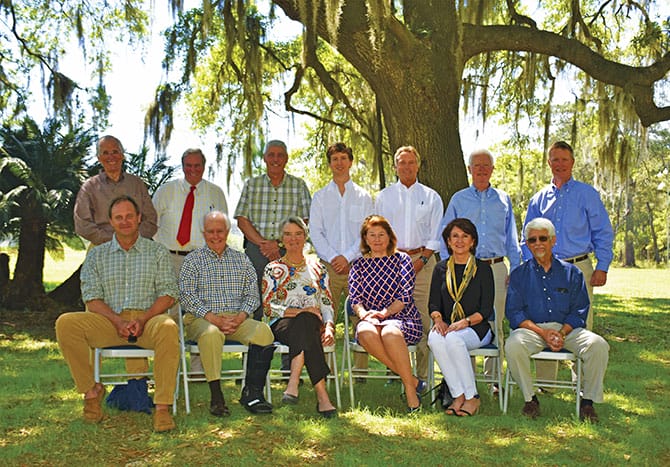
Standing l-r: George Watkins, Ebe Walter*, Reggie Thackston, Redmond Ingalls, Tim Pirrung*, Tom Rankin, George Simmons. Seated l-r: John Thompson, Mason Hawkins, Cornelia Corbett, Daphne Wood, Virginia Wetherell, Rhett Johnson. Not pictured: Charles Chapin, Rosamond Davis, Ken Haddad, Robert Kirby, Wesley Langdale, Karl Miller, David Perkins, Remy Trafelet, and George Willson. *Term ended April 2016.
Tall Timbers receives donations at Quail Forever appreciation dinner
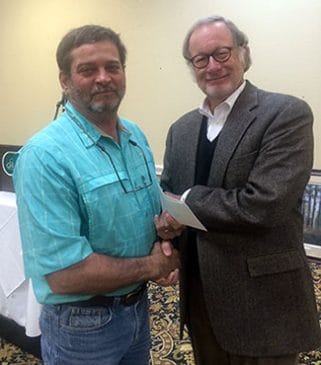
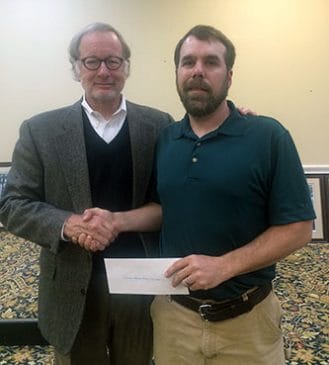
The Southwest Georgia Chapter of Quail Forever held it’s annual landowner appreciation dinner on Thursday, April 7th in Albany, Georgia. The dinner recognized the landowners who provided locations for the groups’ annual fundraising hunt in January—the Georgia Quail Invitational. In addition, chapter president Bobby McKinney announced the recipients of their donations for the year, including several Tall Timbers programs. Clay Sisson, Director of the Albany Quail Project (AQP) and Dixie Plantation Research (DPR) accepted two checks: $15,000 for AQP and $15,000 for DPR. Brent Howze of Georgia DNR Wildlife Resources Division accepted a check for $30,000 for the FL/GA Quail Coalition, which is housed and administered by Tall Timbers. Contributions were also made to Quail Forever’s “No Child Left Indoors” Initiative and their Legislative Action Fund, along with a scholarship donation to the Wildlife Program at Abraham Baldwin Agricultural College (ABAC). A total of $75,000 was donated from the proceeds of this one hunt event; this brings the groups’ total contributions to over $140,000—all of which stays in the southwest Georgia region. A very impressive sum considering the local chapter has only been having these events for two years! An accounting of the local groups’ finances can be found on their web site at swgaquailforever.org, as well as information about the national parent organization at quailforever.org.
At left is Clay Sisson accepting checks from the president of the Southwest Georgia Chapter of Quail Forever, Bobby McKinney; at right is Brent Howze.
On April 14th, the annual Georgia-Florida Turkey Invitational Kick-off Dinner was held for the eleventh year at Osceola Plantation, Thomasville, Georgia thanks to our hosts the Williams and Parker families. Todd Bevis, Director, Professional Development Programs, Office of Science Teaching Activities, Florida State University presented the evening’s program, which focused on the beauty and majesty of the wild turkey and the control of hunt variables when attempting to take a mature gobbler. Proceeds from the event benefit the Game Bird Program at Tall Timbers.
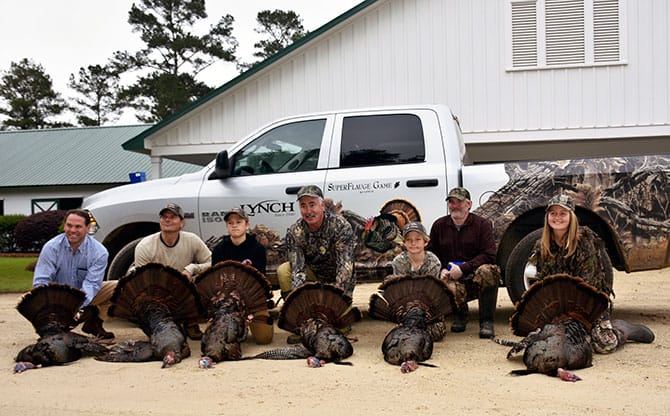
The next morning, over 30 teams took to the woods in search of a winning gobbler. Two-man teams hunted their own lands and returned for the weigh-in at noon. Judge Ricky Lackey, National Wild Turkey Federation Biologist, conducted the weigh-in. Team Walter Hatchett/Tim Pirrung won the overall invitational; the gobbler had a 14-1/8″ beard and 1-7/16″, 1-6/16″ spurs. They were awarded the perpetual Georgia/Florida Turkey Invitational trophy, as well as a Stoeger Model 3000 – 12 gauge shotgun, donated by South Georgia Outdoors, and a custom wooden box containing Lynch Since 1940 turkey calls. Father/son Team Todd and Cayde Bevis took second place, and third place went to Team Gordon Mooney and James Groover.
Pictured left to right: Gordon Mooney (3rd place), father/son team Todd and Cayde Bevis (2nd place), Charlie Ward, Grant Gaston (2nd place youth division) and Greg Gaston and Reagan Sherman (1st place youth division).
First place in the Youth Division went to Reagan Sherman, who was awarded a custom wooden box with a Lynch Since 1940 turkey call, and second place went to Grant Gaston.
The Calcutta was also won by Reagan Sherman with a whopping 20 pound 9 oz. gobbler. Second place went to Team Eric Cohen/Donnie Richards and third place went to Team Gordon Mooney/James Groover.
Thanks to Osceola Plantation for their hospitality and to steering committee members John Daniels, Bryan Knox and Robbie Green for helping pull together a great year!
By Theron M. Terhune, PhD, Game Bird Program Director
The 2016 quail hatch got off to a quick start with some managers reporting bumble-bee sized chicks as early as late April and early May. Our first nest by a radio-tagged hen, however, was not incubated until the first week of May. A flurry of nesting activity since then resulted in good nest production (51 nests produced per 100 hens) early, but slightly lower than average to the mid-season point (15 July) compared to our long-term data. Nest success has been very good at 64%, but lower nest production has resulted in fewer overall broods being produced on the ground — 27 broods produced at the mid-season point per 100 hens alive in April. Adult survival is also slightly off at 59%, compared to our long-term mid-season average of 63%. The good news is that in the Red Hills region nest and brood production is higher than it has been at this point in the last 3 years.
The Albany area is singing a similar tune such that nest and brood production are a little below their 10-year average, but not by much. A big difference in the Albany region is high adult survival (63%), which is well above their long-term average (<50% survival). This survival boon has been attributed to good cover conditions, which is linked to plentiful and timely rainfall. The high survival sets up the remainder of the breeding season nicely for good production and bodes well for a good late season hatch.
Striking News on Chicks
Brood sizes have been fantastic this year. In fact, early season nests contained ~3 more eggs than usual compared to long-term averages; mid-season clutches are also larger than normal. We attribute this to a relatively mild winter, good cover conditions and ample food, producing better-conditioned hens at the start of the breeding season. Similarly, during our brood-capturing efforts, we have observed chicks weighing 1-2 grams heavier at 11-12 days of age. Better conditioned hens result in higher quality eggs, improved egg production and healthier chicks at time of hatch. We have already radio-tagged close to 90 bobwhite chicks this season, and we have not only observed larger chicks, but they seem to be stronger and are flying earlier. Chicks typically are relatively weak flyers at 14 days of age, but this year chicks have been flying out of our capture panels as early as 12 days of age. Taken collectively, chick survival is much improved over last year.
Twenty-four chicks in a single brood capture. Larger than average clutch and brood sizes this year will help to offset the high chick mortality by snakes and other varmints. Photo by Kyle Lunsford
Despite improved chick survival, high chick mortality seems inevitable. Snakes continue to strike. They remain the leading culprit depredating young quail chicks, especially those chicks less than 5 weeks of age. Earlier this season, 4 radio-tagged chicks were depredated by 4 different corn snakes (i.e., red rat snakes) in a single weekend! In North Carolina, a chick mortality event confirmed our suspicion that one snake will eat multiple chicks at a time. We found this was the case in 2 separate incidences — both yellow rat snakes. In the first occurrence, the yellow rat snake consumed 4 chicks (3 radio-tagged, 1 banded-only). In the second incident, a different yellow rat snake depredated 4 chicks (1 radio-tagged, 3banded-only, and 1 untagged). As chicks mature and reach 5-6 weeks of age, snake mortality wanes. However, we continue to see that mammalian predators (bobcats, raccoons, etc.) depredate quail chicks at a high rate also, especially once they reach 5 weeks of age until they are full grown.
Left: Kyle Lunsford, a University of Georgia graduate student, holding a yellow rat snake that depredated 3 less than 3-week-old bobwhite quail chicks. Right: Alex Jackson, a University of Georgia graduate student, holding a red rat snake that depredated a 3-week old radio-tagged bobwhite chick at Dixie Plantation.
Continuing supplement feeding will aid in keeping adult birds in good condition, and hopefully more productive, producing more chicks that are in better condition from time of hatch — poised to grow and fly faster. Year-round trapping of meso-mammalian predators can help to carry more young birds into the fall, especially this time of year, when young chicks are particularly vulnerable.
The M-CORES program, which includes the proposed Suncoast Connector Toll Road in Jefferson County, passed through the Florida Legislature at breakneck speed with little review or analysis. Tall Timbers has a number of concerns given the potential for significant and wide spread impacts. These include fragmenting public and private conservation lands, robbing business from Main Street Monticello, impacting our rivers and other water resources, and making prescribed fire more difficult and costly.
Join us in asking the Jefferson County Board of County Commissioners to OPPOSE the Suncoast Connector toll road and its path through Jefferson County.
Take action now with our easy email form.
Send an email to all five Jefferson County Board of County Commissioners with one click!
Burn prioritization modeling seminars and fire modeling tools are supported by Wildland Fire Science to train managers in the important planning stages of prescribed fires.
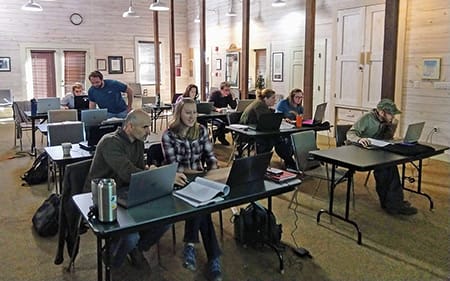
Educating and guiding the next generation of fire researchers and managers is a key goal of Wildland Fire Science and a resource for testing new ideas in fire research.
Tall Timbers hosts the premier fire technology transfer organization—the Southern Fire Exchange. This JFSP funded effort helps connect research to management through webinars, workshops, and support of the Prescribed Fire Science Consortium.
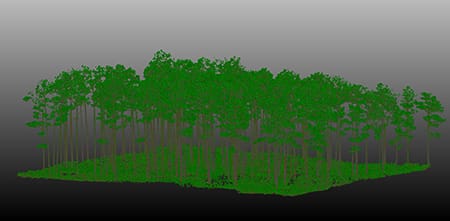
Working with partners in the Prescribed Fire Science Consortium, the program is building nexgen 3-D fuel beds using terrestrial LiDAR and novel sampling techniques to power new fire behavior models for prescribed fire managers. This work links to Tall Timbers work in wildlife habitat usage and ecological forestry.
The Longleaf Legacy landscape prescribed fire burn team arm of Wildland Fire Science works directly with landowners and partners to effectively put fire on the ground and promote prescribed fire throughout the region.
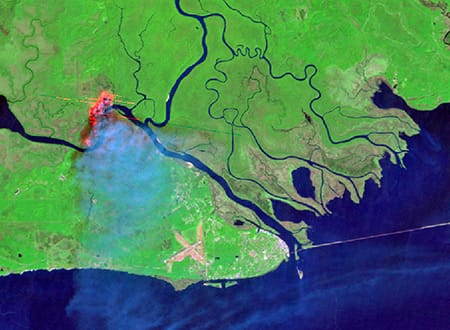
Tall Timbers is leading an effort to map fire regimes at the landscape scale. Staff work with numerous agencies to evaluate fire records and satellite imagery to build this critical conservation database. https://skfb.ly/6DqOY
Tall Timbers hosts the Prescribed Fire Science Consortium, a national network of researchers and managers who promote integrated research and management to advance next generation tools for fire practitioners. https://arcg.is/1DSjDT
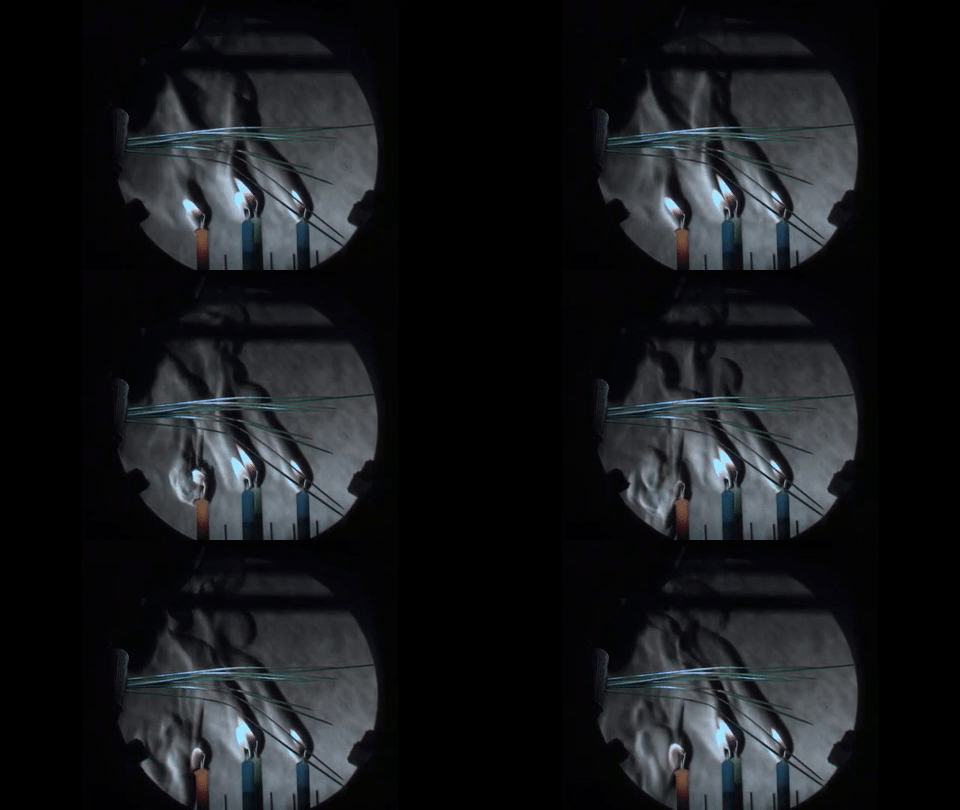
We are linking physics and field observations to understand the fluid dynamics of fire behavior surface fire regimes. Our work combines field observations using advanced thermal imaging techniques, laboratory studies, and coupled fire-atmospheric modeling to help managers improve outcomes of managed fire regimes.
Selected Publications authored by Wildland Fire Science staff.
Staff and researchers support Federal fire training by serving as a cadre for NWCG training courses, ranging from basic wildland fire to advanced fire effects.
(PFTC) specializes in training fire fighters the principles and techniques of prescribed fire through practical hands-on experience. https://www.fws.gov/fire/pftc/
Private land owners are the largest source of prescribed fire in the country. These land owners and the culture of fire that was maintained by them during decades of suppression are a part of why Tall Timbers is a world-wide center for prescribed fire science. Workshops and fire training are a critical focus of the Longleaf Legacy Landscape Burn Team and our support of the Georgia Forestry Commission Prescribed Fire Center in Marion County.
The conserved lands of the Greater Red Hills region are found on working, income-producing properties that support agriculture, forestry, and recreational hunting. These properties contribute $272 million annually to local economies and support 2,300 jobs. [link to Planning & Advocacy section] The landowners’ strong stewardship ethic preserves their working lands while replenishing drinking water supplies, protecting water quality, and providing wildlife habitat for dozens of rare and endangered species. Tall Timbers’ conservation easements on these working properties encourage landowners to retain their traditional livelihood by keeping farms in family ownership.
Home to world-class wild quail populations, the Greater Red Hills region contains the largest concentration of gamebird preserves in the United States. These preserves also support the largest community of Red-cockaded woodpeckers on private lands. Indicators of high quality habitat found here include the gopher tortoise, Bachman’s sparrow, fox squirrel, and many amphibians. Tall Timbers’ conservation easements identify and protect the critical habitats of these species.
The region also boasts outstanding aquatic resources. Large river systems, like the Flint/Apalachicola, Ochlockonee, and Aucilla, flow from Georgia and feed into the Gulf of Mexico to support some of the world’s most productive estuaries. Large disappearing sinkhole lakes, like Iamonia, Miccosukee, and Jackson, provide habitat for an array of aquatic species and migratory birds. Tall Timbers’ conservation easements protect these vital watersheds and wetlands that are the lifeblood for the ecological health of the region.
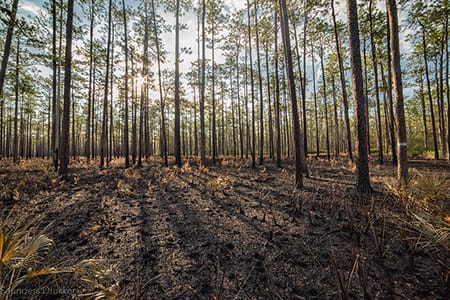
Once dominated by longleaf pine, our pine woodlands support abundant wildlife and local economies. These forests need prescribed fire to stay healthy. Herbert L. Stoddard and his associates Ed and Roy Komarek were pioneers in this emerging scientific field during the mid-20th century. Tall Timbers continues that legacy with applied research on prescribed fire and land management. Today, there is a tremendous need to expand prescribed fire use beyond the Red Hills to ensure ecosystem health and reduce wildfire risk. Additionally, Tall Timbers uses conservation easements to permanently protect private woodlands while balancing the need for economic return from selective timbering.











 The 2016 quail hatch got off to a quick start with some managers reporting bumble-bee sized chicks as early as late April and early May. Our first nest by a radio-tagged hen, however, was not incubated until the first week of May. A flurry of nesting activity since then resulted in good nest production (51 nests produced per 100 hens) early, but slightly lower than average to the mid-season point (15 July) compared to our long-term data. Nest success has been very good at 64%, but lower nest production has resulted in fewer overall broods being produced on the ground — 27 broods produced at the mid-season point per 100 hens alive in April. Adult survival is also slightly off at 59%, compared to our long-term mid-season average of 63%. The good news is that in the Red Hills region nest and brood production is higher than it has been at this point in the last 3 years.