New Regional Game Bird Biologist Joins Tall Timbers
By: Theron M. Terhune, PhD, Game Bird Program Director
We are happy to introduce Mr. Reggie Thackston as the new Regional Game Bird Biologist. He is no newcomer to Tall Timbers or to bobwhite restoration and management. Reggie recently retired from 30 years with the Georgia DNR, Wildlife Resources Division where he served as the Private Lands Program Manager and Bobwhite Quail Project Leader. In this position, he worked closely with Tall Timbers and the Game Bird Program to integrate science-based bobwhite management into policy and planning efforts at the state, regional and national levels. He is a wealth of knowledge, owns and trains bird dogs, and is an avid quail and turkey hunter.
Reggie’s primary focus will be in the Carolina’s aiding landowners, land managers and biologists with the management and monitoring of northern bobwhite quail. Reggie has already hit the ground running, visiting properties in South and North Carolina and conducting covey call counts. He will continue to provide technical assistance to landowners and land managers as well as help to develop a series of training workshops. I am excited to have Reggie join the Game Bird Program and look forward to expanding our footprint to the Carolina region!
By Eric Staller, Natural Resources Coordinator & Land Manager
With the loss of millions of acres of longleaf pine forest in the southeast, there has been a push in natural resource management to reestablish this species in old field and native groundcover systems. An added benefit is that longleaf carry fire easier then old field pines, an imperative tool to manage both systems.
Land managers have used many methods to capture natural regeneration of existing mature longleaf, and many of those methods are the same for site preparation to plant containerized longleaf seedlings. What methods you decide to use for site prep/seed capture depend on your site. Typically site prep and seed capture are implemented in August and September due to the timing of native seed fall and planting recommendations of containerized seedlings. Typical planting or seed capture objectives include good seed to soil contact, adequate sunlight, and decreased competition. Methods to achieve these objectives include disking, mowing, burning and chemical application used singularly, or in conjunction to meet site preparation objectives.
Disking is a common site preparation technique
In old field systems, disking in canopy gaps or under and around mature longleaf have worked well to prepare the seed bed and ensure adequate seed to soil contact. This method gives managers the ability to control where the regeneration is caught, and/or to define the area where seedlings are planted. One drawback of this method is that disking selects for forbs (weeds) in the groundcover, which results in poor fuels for subsequent prescribed burning. Also, disking in native areas (wiregrass dominated systems) should not be conducted, as many of the groundcover species will be negatively impacted by this intense groundcover disturbance.
Mowing and roller chopping have also been used for site prep; these techniques allow sunlight to reach the germinating and planted seedlings. Negative impacts include mowed/chopped debris on the ground, which can inhibit good soil to seed contact, and potentially the build up of too much fuel for burning that can be damaging to new seedlings. Mowing “selects” for grasses, but like disking, roller chopping selects for forbs resulting in reduced fine fuels and soil disturbance of native groundcover.
Under specific conditions only mowed vegetation will burn
Chemical applications or herbicides have been used for decades for site preparation. With today’s selective herbicides, a manger can select for increased grasses (Garlon4 – Triclopyr) or forbs (Arsenal – Imazapyr) depending on their groundcover objectives. The treatments reduce the competition of hardwoods and other groundcover species for germinating or planted seedlings. Negative impacts may include the reduction of plant diversity, and burns after herbicide treatment are significantly higher in fire intensity, which could damage or kill the longleaf seedlings.
Prescribed fire is another tool that is utilized and is imperative in managing both old field and native systems. Fall burning offers excellent seed to soil contact, reduced groundcover competition in the short term, hardwood control, and allows adequate sunlight to the ground. Negative aspects of fall burning include lack of suitable habitat for wildlife until the spring growing season, and if not performed under the correct weather conditions, scorching of mature pine over-story can occur. Burning too late or clean can expose seeds to rodent and bird predation, reducing establishment. Burning in early fall or late summer allows the groundcover to respond, protecting seeds.
Lastly, managers often utilize multiple tools to meet their site prep objectives. Herbicide application followed by burning, or mowing and burning will reduce fuels loads and competition while increasing seed to soil contact. To minimize the negative wildlife issues, managers on old field lands can disk fire breaks around small (1/2 to 1 acre) target areas for seed capture or planting to minimize the number of acres of barren ground throughout the winter. Wet lines (fire breaks utilizing only water) are typically used in the native system, but can be utilized in old field situations too.
This year at Tall Timbers, we used two treatments for our site preparation for planting containerized seedlings: 1) mowing and burning in September, and 2) chemical application of Triclopyr in July, followed by mowing and burning in September. The planting of seedlings will occur in November or December of 2015. The site we are planting is hilly, and besides planting longleaf, we also want to increase the grass component, therefore we are not using fire breaks around our planting areas, which would select for forbs and potentially increase erosion. Instead of fire breaks, we burned the areas two days after we mowed, under weather conditions in which mowed vegetation would burn and standing, un-mowed vegetation would naturally extinguish the fire. In the 1-year roughs, we burned with low relative humidity (RH) ~25%, in the 2-year roughs; we burned with ~45% RH. Another advantage to this technique is that when the entire burn unit is burned again, the planted areas will have six months less fuel build up, so fire intensity will be lower in the planted areas to ensure no harm to the new seedlings. In years to come we will continue to develop this mow and burn without firebreaks technique to capture more natural regeneration from our mature trees, thereby reducing our need to buy containerized longleaf seedlings. Whichever tools you use, understanding how sites will burn under various weather conditions is critical when burning without fire breaks, and to meet groundcover, over-story, and wildlife objectives.
If you are trying to restore your forest to longleaf it is important that you first consider your site, your soils, and your objectives for the forest. After carefully considering these objectives, you will be better able to determine what method of site preparation will work best for your landscape and will most quickly meet your needs.
By Kevin Robertson, PhD, Fire Ecology Program Director
The Fire Ecology Program has launched the Tall Timbers Dendrochronology Lab. Dendrochronology is the study of tree rings to reconstruct aspects of the history of an area, including the fire regime recorded by fire scars, as well as climatic patterns reflected by tree growth patterns. Fire scars can record both the year and the season when fires occurred. Gaining knowledge regarding historic fire regimes is of great interest for understanding fire as a natural and cultural ecological process. It is also important for defending the practice of prescribed burning by placing it in a larger historical and ecological context.
Dr. Jean Huffman, who is one of only two dendrochronologists who have published fire history reconstructions from tree scars in the southeastern U.S. Coastal Plain, is joining forces with the Tall Timbers Fire Ecology Program. She plans to continue the remarkable work she has initiated near the St. Joseph Peninsula, central Florida sand ridges, and the Red Hills Region. Although this collaboration has been in the works for some time, the timing is prodigious as the Program’s new Fire Ecologist, Dr. Monica Rother, has been trained in dendrochronology by one of the world’s foremost experts in the field (Dr. Henry Grissino-Mayer, University of Tennessee, Knoxville).
Initial efforts will focus on completing Dr. Huffman’s work on samples taken from the St. Joseph Peninsula State Buffer Preserve. Some samples record fires in the 1600s with a more complete chronology in the 1700s onward. The process will involve moving the samples (cross sections or whole stumps) to Tall Timbers, cutting and sanding cross-sections as needed to scan high resolution images, creating a “chronology” by matching rings of given years among samples with help from specialized software, and then applying a great deal of skill and training to interpret fire scars and reconstruct fire regimes.
This work comes at a critical time in history, when we are rapidly losing the very old stumps that record fire regimes into past centuries. The loss has been driven in part by the practice of “stumping,” or removing the stumps of trees after they are cut to make mulch and remove obstacles to vehicles. Also, they are burned up by prescribed fire and wildfire if not recognized and protected or sampled in time. With this new effort, Tall Timbers is seizing the fading opportunity to peer into the distant past at the fires that have brought us the amazing ecosystems we enjoy today.
Above, Cross section of a scarred tree showing multiple fire scars. At right, Dr. Jean Huffman at the Wade Tract by the kind of fire-scarred tree that can record multiple fires.
By Theron M. Terhune, PhD, Game Bird Program Director
Florida Beggarweed (Desmodium tortuosum) an herb in the pea/bean family, also known as “Dixie Ticktrefoil” or simply “Beggar-tick” or “Beggar-lice,” is one of many (~76) beggarweed species. The leaves, stems and seeds are covered in tiny hairs that catch on hair, clothing, and fur. These sticky seeds hitch rides on just about anything it comes into contact with, aiding in its propagation. It can wreak havoc on a wire-haired bird dog. The good news is that beggarweed is a highly nutritious and commonly preferred native food of bobwhite during the fall and winter. Soil disturbance through prescribed fire and/or winter disking may encourage next year’s beggarweed crop, and when combined with timely rainfall it can be prolific. The woods this year are teeming with beggarweed, acorns, and other seeds. In fact, if there is any correlation in the amount of beggarweed and the abundance of quail then we should be in good shape this hunting season here in the Red Hills!
The 2015 hatch in the Red Hills and Albany area was much improved over last year and moderately above our long-term average. Breeding season survival was below average this year, whereas the number of nests and broods produced per hen was slightly above average (see Figure 1). Ample, but not too much, rainfall early and mid-growing season provided good cover and quality insect habitat for bobwhite chicks yielding good chick survival. In addition, a strong late season hatch resulted in a good crop of late birds recruited into the fall population—this was corroborated by reports from the first hunts of the year. Our preliminary results from covey call counts indicate that bird numbers are moderately up from last year on most properties. Maybe there actually is a correlation between the amount of Beggarweed and quail—if not the quail should have plenty to eat with the bounty of native food available this year which may impact how tightly linked (or not) coveys are to supplemental feed early in the 2015|16 hunting season.
Figure 1. Survival of radio-tagged bobwhites and the number of nests and broods produced per 100 hens on Tall Timbers, 2008–2015.
Tall Timbers would like to thank the Southeastern Wildlife Exposition (SEWE) as well as Garden & Gun Magazine for including Tall Timbers in the 36th annual celebration of wildlife & sporting art in Charleston, South Carolina. The Cocktails & Conservation event, Saturday, February 17, hosted by Garden & Gun, featured our very own Dr. Bill Palmer and Garden & Gun contributing author Eddie Nickens. The two gentlemen shared their knowledge on quail, land management and prescribed fire with the over 200 event attendees. It was a wonderful opportunity for Tall Timbers to be in the spotlight with wildlife enthusiasts.
Click here to see a SEWE recap video that includes a comment by Bill Palmer.
Pictured L-R: David DiBenedetto (VP for Garden & Gun), Eddie Nickens and Bill Palmer
The M-CORES program, which includes the proposed Suncoast Connector Toll Road in Jefferson County, passed through the Florida Legislature at breakneck speed with little review or analysis. Tall Timbers has a number of concerns given the potential for significant and wide spread impacts. These include fragmenting public and private conservation lands, robbing business from Main Street Monticello, impacting our rivers and other water resources, and making prescribed fire more difficult and costly.
Join us in asking the Jefferson County Board of County Commissioners to OPPOSE the Suncoast Connector toll road and its path through Jefferson County.
Take action now with our easy email form.
Send an email to all five Jefferson County Board of County Commissioners with one click!
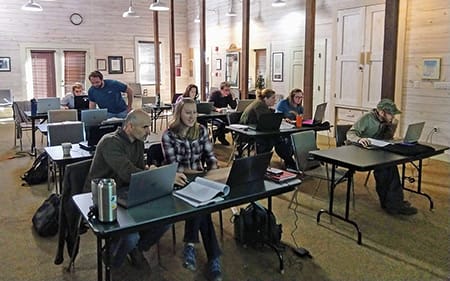
Burn prioritization modeling seminars and fire modeling tools are supported by Wildland Fire Science to train managers in the important planning stages of prescribed fires.
Educating and guiding the next generation of fire researchers and managers is a key goal of Wildland Fire Science and a resource for testing new ideas in fire research.
Tall Timbers hosts the premier fire technology transfer organization—the Southern Fire Exchange. This JFSP funded effort helps connect research to management through webinars, workshops, and support of the Prescribed Fire Science Consortium.
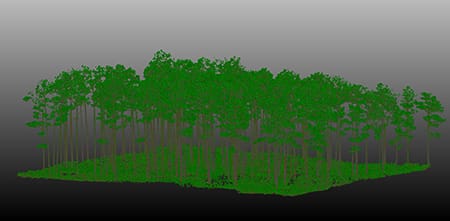
Working with partners in the Prescribed Fire Science Consortium, the program is building nexgen 3-D fuel beds using terrestrial LiDAR and novel sampling techniques to power new fire behavior models for prescribed fire managers. This work links to Tall Timbers work in wildlife habitat usage and ecological forestry.
The Longleaf Legacy landscape prescribed fire burn team arm of Wildland Fire Science works directly with landowners and partners to effectively put fire on the ground and promote prescribed fire throughout the region.
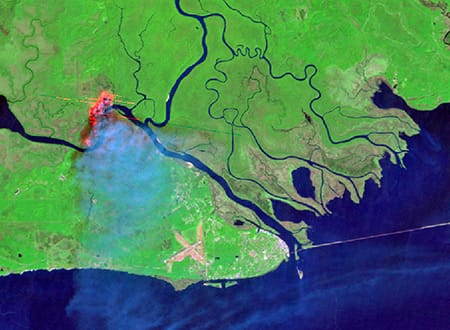
Tall Timbers is leading an effort to map fire regimes at the landscape scale. Staff work with numerous agencies to evaluate fire records and satellite imagery to build this critical conservation database. https://skfb.ly/6DqOY
Tall Timbers hosts the Prescribed Fire Science Consortium, a national network of researchers and managers who promote integrated research and management to advance next generation tools for fire practitioners. https://arcg.is/1DSjDT
We are linking physics and field observations to understand the fluid dynamics of fire behavior surface fire regimes. Our work combines field observations using advanced thermal imaging techniques, laboratory studies, and coupled fire-atmospheric modeling to help managers improve outcomes of managed fire regimes.
Selected Publications authored by Wildland Fire Science staff.
Staff and researchers support Federal fire training by serving as a cadre for NWCG training courses, ranging from basic wildland fire to advanced fire effects.
(PFTC) specializes in training fire fighters the principles and techniques of prescribed fire through practical hands-on experience. https://www.fws.gov/fire/pftc/
Private land owners are the largest source of prescribed fire in the country. These land owners and the culture of fire that was maintained by them during decades of suppression are a part of why Tall Timbers is a world-wide center for prescribed fire science. Workshops and fire training are a critical focus of the Longleaf Legacy Landscape Burn Team and our support of the Georgia Forestry Commission Prescribed Fire Center in Marion County.
The conserved lands of the Greater Red Hills region are found on working, income-producing properties that support agriculture, forestry, and recreational hunting. These properties contribute $272 million annually to local economies and support 2,300 jobs. [link to Planning & Advocacy section] The landowners’ strong stewardship ethic preserves their working lands while replenishing drinking water supplies, protecting water quality, and providing wildlife habitat for dozens of rare and endangered species. Tall Timbers’ conservation easements on these working properties encourage landowners to retain their traditional livelihood by keeping farms in family ownership.
Home to world-class wild quail populations, the Greater Red Hills region contains the largest concentration of gamebird preserves in the United States. These preserves also support the largest community of Red-cockaded woodpeckers on private lands. Indicators of high quality habitat found here include the gopher tortoise, Bachman’s sparrow, fox squirrel, and many amphibians. Tall Timbers’ conservation easements identify and protect the critical habitats of these species.
The region also boasts outstanding aquatic resources. Large river systems, like the Flint/Apalachicola, Ochlockonee, and Aucilla, flow from Georgia and feed into the Gulf of Mexico to support some of the world’s most productive estuaries. Large disappearing sinkhole lakes, like Iamonia, Miccosukee, and Jackson, provide habitat for an array of aquatic species and migratory birds. Tall Timbers’ conservation easements protect these vital watersheds and wetlands that are the lifeblood for the ecological health of the region.
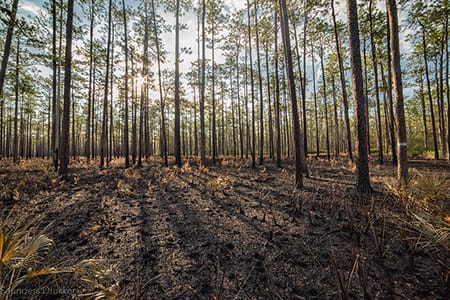
Once dominated by longleaf pine, our pine woodlands support abundant wildlife and local economies. These forests need prescribed fire to stay healthy. Herbert L. Stoddard and his associates Ed and Roy Komarek were pioneers in this emerging scientific field during the mid-20th century. Tall Timbers continues that legacy with applied research on prescribed fire and land management. Today, there is a tremendous need to expand prescribed fire use beyond the Red Hills to ensure ecosystem health and reduce wildfire risk. Additionally, Tall Timbers uses conservation easements to permanently protect private woodlands while balancing the need for economic return from selective timbering.


 We are happy to introduce Mr. Reggie Thackston as the new Regional Game Bird Biologist. He is no newcomer to Tall Timbers or to bobwhite restoration and management. Reggie recently retired from 30 years with the Georgia DNR, Wildlife Resources Division where he served as the Private Lands Program Manager and Bobwhite Quail Project Leader. In this position, he worked closely with Tall Timbers and the Game Bird Program to integrate science-based bobwhite management into policy and planning efforts at the state, regional and national levels. He is a wealth of knowledge, owns and trains bird dogs, and is an avid quail and turkey hunter.


.jpg?strip=all&resize=336%2C252 "Small acre patches can minimize negative wildlife impacts") This year at Tall Timbers, we used two treatments for our site preparation for planting containerized seedlings: 1) mowing and burning in September, and 2) chemical application of Triclopyr in July, followed by mowing and burning in September. The planting of seedlings will occur in November or December of 2015. The site we are planting is hilly, and besides planting longleaf, we also want to increase the grass component, therefore we are not using fire breaks around our planting areas, which would select for forbs and potentially increase erosion. Instead of fire breaks, we burned the areas two days after we mowed, under weather conditions in which mowed vegetation would burn and standing, un-mowed vegetation would naturally extinguish the fire. In the 1-year roughs, we burned with low relative humidity (RH) ~25%, in the 2-year roughs; we burned with ~45% RH. Another advantage to this technique is that when the entire burn unit is burned again, the planted areas will have six months less fuel build up, so fire intensity will be lower in the planted areas to ensure no harm to the new seedlings. In years to come we will continue to develop this mow and burn without firebreaks technique to capture more natural regeneration from our mature trees, thereby reducing our need to buy containerized longleaf seedlings. Whichever tools you use, understanding how sites will burn under various weather conditions is critical when burning without fire breaks, and to meet groundcover, over-story, and wildlife objectives.
This year at Tall Timbers, we used two treatments for our site preparation for planting containerized seedlings: 1) mowing and burning in September, and 2) chemical application of Triclopyr in July, followed by mowing and burning in September. The planting of seedlings will occur in November or December of 2015. The site we are planting is hilly, and besides planting longleaf, we also want to increase the grass component, therefore we are not using fire breaks around our planting areas, which would select for forbs and potentially increase erosion. Instead of fire breaks, we burned the areas two days after we mowed, under weather conditions in which mowed vegetation would burn and standing, un-mowed vegetation would naturally extinguish the fire. In the 1-year roughs, we burned with low relative humidity (RH) ~25%, in the 2-year roughs; we burned with ~45% RH. Another advantage to this technique is that when the entire burn unit is burned again, the planted areas will have six months less fuel build up, so fire intensity will be lower in the planted areas to ensure no harm to the new seedlings. In years to come we will continue to develop this mow and burn without firebreaks technique to capture more natural regeneration from our mature trees, thereby reducing our need to buy containerized longleaf seedlings. Whichever tools you use, understanding how sites will burn under various weather conditions is critical when burning without fire breaks, and to meet groundcover, over-story, and wildlife objectives.
 The Fire Ecology Program has launched the Tall Timbers Dendrochronology Lab. Dendrochronology is the study of tree rings to reconstruct aspects of the history of an area, including the fire regime recorded by fire scars, as well as climatic patterns reflected by tree growth patterns. Fire scars can record both the year and the season when fires occurred. Gaining knowledge regarding historic fire regimes is of great interest for understanding fire as a natural and cultural ecological process. It is also important for defending the practice of prescribed burning by placing it in a larger historical and ecological context.
 Initial efforts will focus on completing Dr. Huffman’s work on samples taken from the St. Joseph Peninsula State Buffer Preserve. Some samples record fires in the 1600s with a more complete chronology in the 1700s onward. The process will involve moving the samples (cross sections or whole stumps) to Tall Timbers, cutting and sanding cross-sections as needed to scan high resolution images, creating a “chronology” by matching rings of given years among samples with help from specialized software, and then applying a great deal of skill and training to interpret fire scars and reconstruct fire regimes.
 Florida Beggarweed (Desmodium tortuosum) an herb in the pea/bean family, also known as “Dixie Ticktrefoil” or simply “Beggar-tick” or “Beggar-lice,” is one of many (~76) beggarweed species. The leaves, stems and seeds are covered in tiny hairs that catch on hair, clothing, and fur. These sticky seeds hitch rides on just about anything it comes into contact with, aiding in its propagation. It can wreak havoc on a wire-haired bird dog. The good news is that beggarweed is a highly nutritious and commonly preferred native food of bobwhite during the fall and winter. Soil disturbance through prescribed fire and/or winter disking may encourage next year’s beggarweed crop, and when combined with timely rainfall it can be prolific. The woods this year are teeming with beggarweed, acorns, and other seeds. In fact, if there is any correlation in the amount of beggarweed and the abundance of quail then we should be in good shape this hunting season here in the Red Hills!